Monday, March 2, 2015

What to Expect from the ELA Smarter Balanced Test

It's the question everyone really wants to know.  We've never seen this test before.  What should we expect?  

Smarter Balanced has published "Stimulus Specifications" that may give us a clearer picture of what our students can expect to see.

Students in K-5 apply the Reading standards to the following range of text types, with texts selected from a broad range of cultures and periods.

Because students have a limited amount of time to complete an assessment, expecting them to read and comprehend lengthy texts is unrealistic.  The table below presents minimum and maximum word counts for texts to be used in Smarter Balanced items/tasks.  Short texts contain 75% or less of the maximum number of words allowed in long texts.


Lexile levels for Common Core State Standards grade bands are shown in the following chart.


TEXT COMPLEXITY


Text complexity consists of three equally important parts:

Qualitative dimensions of text complexity refer to those aspects best measured or only measurable by an attentive human reader, such as levels of meaning or purpose; structure; language conventionality and clarity; and knowledge demands.

Quantitative dimensions of text complexity refer to those aspects such as word length or frequency, sentence length, and text cohesion, that are difficult, if not impossible, for a human reader to evaluate efficiently, especially in long texts, and are thus today typically measured by computer software.

Reader and task considerations take into account variables specific to particular readers (such as motivation, knowledge, and experiences) and to particular tasks (such as purpose and the complexity of the task assigned and the questions posed).  Such assessments are best made by teachers employing their professional judgment, experience, and knowledge of their students and the subject.

The following rubric is used for examining literary texts:


Below is an example worksheet of literary text complexity analysis.  Following the example are options for worksheets to use to determine text complexity.


Analysis worksheet from PARCC online

The following rubric is used for examining informational texts:


Teaching Channel offers a glimpse into assessing text complexity:


Tuesday, February 24, 2015

LNW Survey Results

Thank you for providing feedback on this year's Literacy the Nixa Way PD!  We're looking forward to planning LNW 2015-2016 and will use the data collected to guide the way.

Here are the "TOP TEN" results for the most useful activities from 2014-2015:

# 1 -  FIELD TRIPS
# 2 -  Collaborative planning time
# 3 -  SBG discussions
# 4 -  Dialogue with Dr. Kopp
# 5 -  Collaboratively scoring writing samples
# 6 -  Workshop model review
# 7 -  LNW blog
# 8 -  Update writing inventory scoring guides
# 9 -  Practice writing anecdotal records
#10 - Individual coaching sessions

Tuesday, February 17, 2015

Into the Book - Reading Resources


Into the Book is a site designed to help improve elementary students' reading comprehension.  It focuses on eight key elements of reading:

  • prior knowledge
  • making connections
  • questioning
  • visualizing
  • inferring
  • summarizing
  • evaluating
  • synthesizing
Once you select one of the focuses, you will find the teacher activity guide, lessons, suggested book lists, videos, posters, and songs.

Thanks for sharing this resources with us, Kim Brubaker!


Monday, February 9, 2015

LNW SURVEY

We are continuing to collect information through another LNW survey, similar to last year.  If you did not complete the survey during your last LNW session, please use the link below to complete the survey.  


Your answers will be anonymous and honest feedback is appreciated to help make LNW the best it can be for year three!

Monday, February 2, 2015

Beg, Borrow, and Steal from 3rd, 4th, 5th, and Kindergarten Teachers

Argh, mateys!  We're continuing our begging, borrowing, and stealing of ideas this week!  We spent some time in third, fourth, fifth, and kindergarten classrooms and have some treasures to share. :-)

Kelly Binder and Cindy Marquardt shared some Pandora stations they enjoy using in their classrooms for independent writing time.  The students in Kelly Binder's kindergarten were very engaged and loved writing with soft, instrumental music playing in the background.  Check out Lorie Line and Emile Pandolfi next time you are on Pandora.

Students in Mandi Williams' 3rd grade were working on a unit of study - Literal and Non-literal Language in Reading and Writing.  Look how Mandi connected what they were studying to her vocabulary instruction and how she used technology to bring similes to life in movies and music.


Emalie Lindsey, 4th grade teacher at Mathews, was a real trooper this week!  Her household was battling the yuckies and she had been out the entire week.  She returned to work on Monday AND welcomed 20+ teachers into her classroom!  The students reviewed plot, sharing their brain-friendly movements to remember the rising action, climax, and falling action.  Ask Emalie to show you the motions of her plot tune next time you see her.


In Layne Eckhardt's 5th grade classroom at Summit, students had been studying theme by analyzing song lyrics.  The song they were analyzing on our visit was "Man in the Mirror" by Michael Jackson.  Students first read through the lyrics highlighting things that they thought might help them determine the theme.  Then, students reread the lyrics jotting notes about why they highlighted certain words or phrases.  Students shared with their group, reread the lyrics while listening to the song, and added highlights or notes.  Finally, they gathered together and shared whole group what they had highlighted and why while Layne recorded their thoughts on the Smart board.


After the mini-lesson, students read independently in their literature circle books or met with the teacher to discuss their literature circle book.  Layne utilized talking chips with her small group to ensure that each student participated in the discussion.  She also turned on a small light to remind students outside the group not to interrupt the discussion.


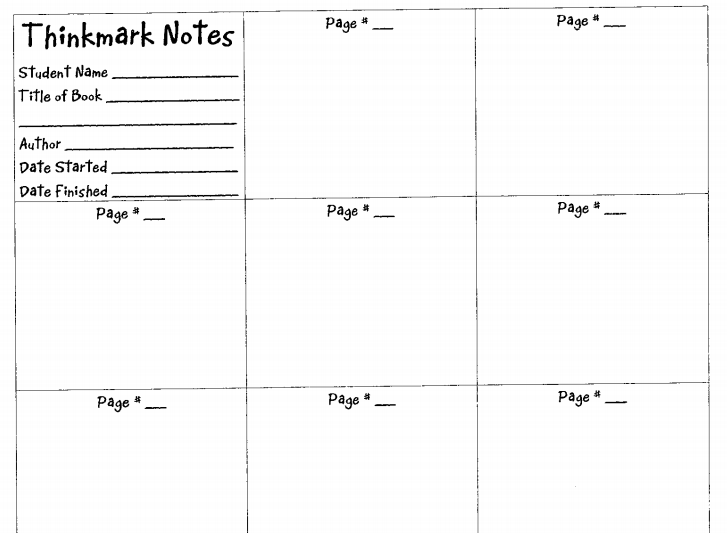
Meredith Carrisalez and LeAndre Jackson, fifth grade teachers at Summit, shared an alternative to using sticky notes for students to record their thinking.  It was an idea they learned during Star Summit in the fall.  "Thinkmarks" are tri-folded and serve a double-purpose--a bookmark and a place to jot their thinking as they read.  You can get a copy of the Thinkmarks HERE.

https://drive.google.com/file/d/0B-MagiKdVa1CZ2dzUkNUTXljQTA/view?usp=sharing

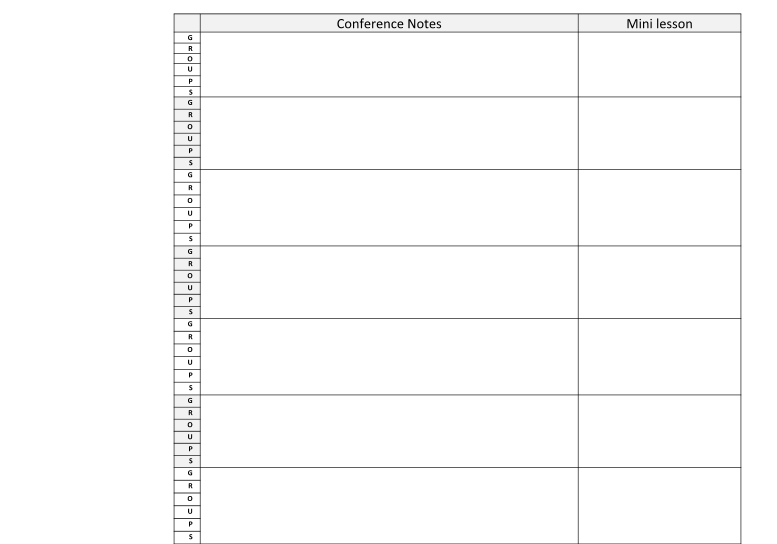
After our LNW discussion on anecdotal records, Meredith created and shared an electronic version of one of the anecdotal forms her group wanted to try out.

https://drive.google.com/file/d/0B-MagiKdVa1CakVUTURqcDd0OGc/view?usp=sharing

Josh Bennett, fifth grade, JTSD, and his group were discussing FCAT resources.  One example in particular was on cause and effect.  Check out the resource they were sharing HERE.

http://fcit.usf.edu/fcat/strategies/ce/default.htm